
Pressure Cooker, Not Panic

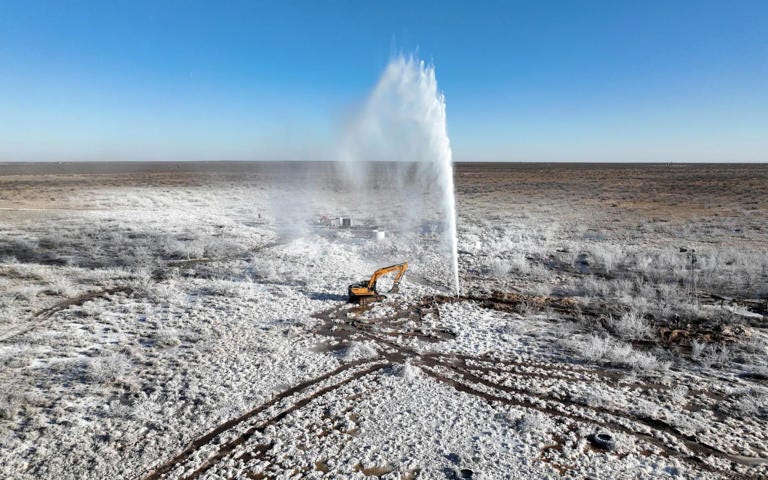
In 2022, a column of saltwater shot more than 100 feet into the air from an abandoned oil well near Tubbs Corner, a sparsely populated crossroads in Crane County, Texas. The eruption startled nearby landowners and forced regulators to act quickly. The well was plugged. The surface stabilized. The incident faded from public view.
But the underground pressure didn’t disappear.
Nearly two years later, saltwater began seeping from a different abandoned well nearby. Scientists studying the area concluded that sealing the first well had likely redirected subsurface pressure rather than relieving it — forcing fluids to find a new escape route through the region’s aging oil-field infrastructure.
It took the Texas Railroad Commission 53 days and roughly $2.5 million to plug the second leak. Not long after, the agency quietly shut in nearby wastewater injection wells believed to be contributing to the pressure buildup. Even now, satellite data shows slight ground uplift in the area — a sign, researchers say, that pressure may be accumulating again.
The episode at Tubbs Corner is no longer viewed as an isolated accident. It has become a case study in what happens when the world’s most productive oil basin collides with its own success.
The Other Output of the Permian
The Permian Basin, which stretches across West Texas and southeastern New Mexico, produces nearly half of all U.S. crude oil. What it produces even more of is water.
As oil wells age, they yield increasing volumes of salty wastewater — known in the industry as produced water — that comes up alongside hydrocarbons. In the Permian, that water now outpaces oil by several multiples. It must be handled, transported, and disposed of safely.
For decades, the solution was straightforward: inject it deep underground into porous rock formations isolated from drinking-water sources. The system worked — until the scale changed.
As production surged, so did injection volumes. In some regions, that pressure triggered earthquakes, prompting regulators to restrict deep injection. Operators shifted disposal into shallower formations instead, often closer to legacy wells drilled decades ago under looser standards.
What followed was not a single failure, but a pattern.
Pressure built underground. Fluids migrated laterally and upward. Old wells — some poorly documented, others corroded by time and salt — became unintended pathways back to the surface.
The result has been a slow, expensive game of whack-a-mole: plug one leak, monitor the area, wait for pressure to surface somewhere else.
Regulators in a Bind
Texas regulators face a difficult balancing act. Oil and gas production remains central to the state’s economy, employment base, and tax revenues. Curtailing it outright is neither politically nor economically viable.
At the same time, visible surface leaks, landowner complaints, and groundwater concerns risk eroding public trust in both the industry and its regulators.
Complicating matters further, neighboring New Mexico has tightened restrictions on wastewater disposal, pushing an even larger share of the Permian’s produced water into Texas injection wells.
Internal documents reviewed by The Wall Street Journal show that researchers at the University of Texas’ Bureau of Economic Geology warned regulators that operators were injecting wastewater with insufficient attention to how fluids might migrate underground or affect reservoir pressure. Left unmanaged, they wrote, the practice would lead to waste, regulatory intervention, and declining value of disposal capacity.
In response, the Railroad Commission has begun relying more heavily on satellite data to detect ground movement and pressure anomalies. Earlier this year, it announced plans to impose limits on injection volumes in certain areas. The Texas Legislature has allocated funding to expand investigative teams and plug thousands of abandoned wells statewide.
The goal is not to stop injection, but to manage it as a finite, pressure-sensitive resource.
Adaptation, Not Abandonment
What’s striking about the situation is what hasn’t happened.
Despite rising complexity, the Permian continues to produce at record levels. Major operators have not fled the basin. Instead, they’ve adapted — quietly and incrementally.
Drillers are now fortifying wells with additional strings of casing to isolate pressure zones. They’re using more advanced coatings to protect steel from corrosive saltwater. Well designs have grown more complex, and drilling costs have increased accordingly.
“Bit by bit, it adds cost, it adds complexity, it adds mechanical challenges,” said Neal, a Chevron executive, in comments reported by the Journal. He noted that the pressure buildup has not caused material disruption to Chevron’s operations.
That distinction matters.
This is not a collapse story. It’s a cost-creep story.
Each added casing string, each upgraded coating, each additional engineering safeguard raises the marginal cost of doing business. Large operators can absorb those costs more easily than smaller ones. Over time, the basin becomes more capital-intensive, more regulated, and less forgiving of mistakes.
When Water Becomes a Strategic Risk
Pressure isn’t just affecting disposal zones. Some operators report that injected water is migrating into producing reservoirs, interfering with oil and gas production itself. Earlier this year, Pecos Valley, a Permian operator, sued water-handling company NGL, alleging that improperly managed injection flooded several of its wells. NGL has denied the claims.
Landowners are also feeling exposed. In Pecos County, a well on rancher Laura Briggs’ property began spraying saltwater “like a fire hydrant,” she said. It took regulators four months and about $350,000 to plug.
Others worry about groundwater contamination — not as a theoretical risk, but as a business-ending one.
“If it breaks loose in a zone where we’re drawing stock water from, it could put you out of business overnight,” said Brad Gholson, a rancher and feed supplier in Reeves County.
An Unresolved Question
The industry is experimenting with alternatives: treating produced water for reuse, evaporating it more efficiently, even releasing treated water into rivers under strict permits. Texas lawmakers have passed legislation to encourage such efforts.
But researchers caution that these solutions won’t scale quickly enough to eliminate injection in the near term.
That leaves a fundamental question hanging over the Permian’s future: if deep injection is constrained by seismic risk, and shallow injection is constrained by surface flows and pressure buildup, where does the water go?
For now, the answer is management, not elimination — better science, tighter limits, and higher costs spread “bit by bit” across the basin.
Pressure doesn’t moralize. It redistributes.
And in the Permian Basin, it is reshaping not just the subsurface, but the economics and governance of America’s most important oil field.
Lauren McAllister is an oil and gas industry reporter covering the intersection of energy markets, regulatory policy, and community impact. Her work often highlights the balance between innovation, environmental responsibility, and the realities of keeping the world powered.
ESG University republishes their articles, features and stories online and/or in print under Creative Commons license CC BY-NC-ND 4.0.
Everyday your story is being told by someone. Who is telling your story? Who are you telling your story to?
Email your sustainable story ideas, professional press releases or podcast submissions to thecontentcreationstudios(AT)gmail(DOT)com.
CLICK HERE FOR SPECIAL PARAMOUNT + DISCOUNT LINK